News on Medial

Related News

Here is how Skydo addressing challenges in B2B cross-border payments

EntrackrEntrackr · 1y ago
Here is how Skydo addressing challenges in B2B cross-border payments
Medial

Bengaluru-based fintech firm Skydo aspires to make cross-border B2B payments much more hassle-free and address common challenges such as steep forex charges. Founded in 2022 by former Ola executives Movin Jain and Srivatsan Sridhar, the company aims to tap into the massive market of cross-border payments, which is dominated by global players like PayPal and Stripe. We spoke to cofounder and CEO Sridhar to learn more about Skydo, how it works, and what is the roadmap ahead. Here are the edited excerpts: How did you come up with the idea of Skydo? My co-founder Movin Jain and I used to work together at Ola. This was about six years back and we’ve been good friends since then. I’ve been mostly doing business roles throughout my career. First year at McKinsey, then for several years in startups and in between for about six years I ran my family-owned business. Movin has been an engineering and product guy and most recently before we started up he was actually at Phonepe, leading the payments platform. So given I have been a manufacturing exporter myself, somehow you know making life simple for exports, figuring out the problems that exporters have in terms of the complicated foreign exchange and other things that they have to deal with has been on my mind. But I never kind of thought about it consciously until we started brainstorming about which space we have to build in. Given Movin’s recent stint in payments, he was very excited about payments and the value of technology in improving payments. So since we were brainstorming about payments, some of my experiences studying the payments and wanting to solve for them came to our thinking and then we kind of started deeply digging into whether these problems are real, how can we solve them as a small company, what kind of actual issues do exporters face on a ground level, let’s talk to a few people and understand. And as we did the initial research, we realized that this is actually a real problem and it’s worth solving and this is a large enough market for us to solve it in. So this was largely the genesis of Skydo. What are the key challenges in payments and exports, cross-border payments that have not been addressed yet and how do you plan to address this? Up until 20-30 years ago, inter-entity payments were slow and cumbersome, often involving manual processes like cheque writing. International wire transfers were particularly sluggish and document-heavy. However, the likes of PayPal, business and international payments have transitioned to facilitate online transactions globally. Conventional banking systems have also significantly improved their infrastructure, with the inclusion of faster payment systems within domestic countries. This robust infrastructure, coupled with various payment options, enables companies like us with the right tools to address unsolved customer challenges. Moreover, consumers now expect instant payments, regardless of geography. Though things like compliance pose another hurdle, with varying regulations across countries causing confusion and complexity. Simplifying and standardizing compliance procedures can enable seamless international payments and business transactions. While companies like Skydo are lowering costs, there still remains room to tackle margins through technological solutions. While issues like Forex hedging and treasury management exist, addressing these concerns should be the next frontier in the payment landscape. Can you take us through how Skydo has performed since inception. So we started the company exactly two years back in March of 2022. It took us about seven months to launch the product after our first set of partnerships and approvals came. We launched in November 2022 with a small pilot batch and since January of 2023, we have been gradually and systematically scaling the business. Today, we have onboarded close to 2,500 businesses and currently our rate of acquiring new businesses is almost 500 to 600 businesses every month. So, this number is doubled, the customer base is doubled at the end of March from what it was at the end of December 2023. And I think at this pace of growth, it looks like it is going to sustain for quite a bit of time now. From onboarding, then if I look at the total payments processed, we are currently processing about $50 million of payments. This again is growing quite strongly and I think by the end of next year, that is the March of 2025, we hope to be processing over $750 million of payments annually. That is the kind of scale that we are looking at. What are your goals in terms of product and business expansion? So in the short term, obviously we want to really scale and hold a very large market share for Indian small businesses. I think that will keep us busy for the next couple of years at least. Although we will also follow this with multiple product features that will be required to make this happen from creating more countries where we can have local collections, enabling credit card payments, enabling two-way payments both from India to outward and along with the export payments that today exist and so on. So there’s an entire product roadmap that will support this growth in India. We also have to be looking for multiple licenses throughout the world. We have already applied and are waiting for approval for the payment aggregator license that RBI gives for cross-border companies. But in addition, we will be looking for multiple licensing in other geographies that will allow us to slowly and steadily expand to more corridors beyond India, which is slightly on the longer term plan. Apart from payments, the diversification is primarily into software to start with. Over time, when we have a very large scale, we might diversify into commerce as well as working capital. But that is very long term.

No hurry to sell, indefinite horizon on Zomato holding: Sanjeev Bikhchandani

EntrackrEntrackr · 1y ago
No hurry to sell, indefinite horizon on Zomato holding: Sanjeev Bikhchandani
Medial

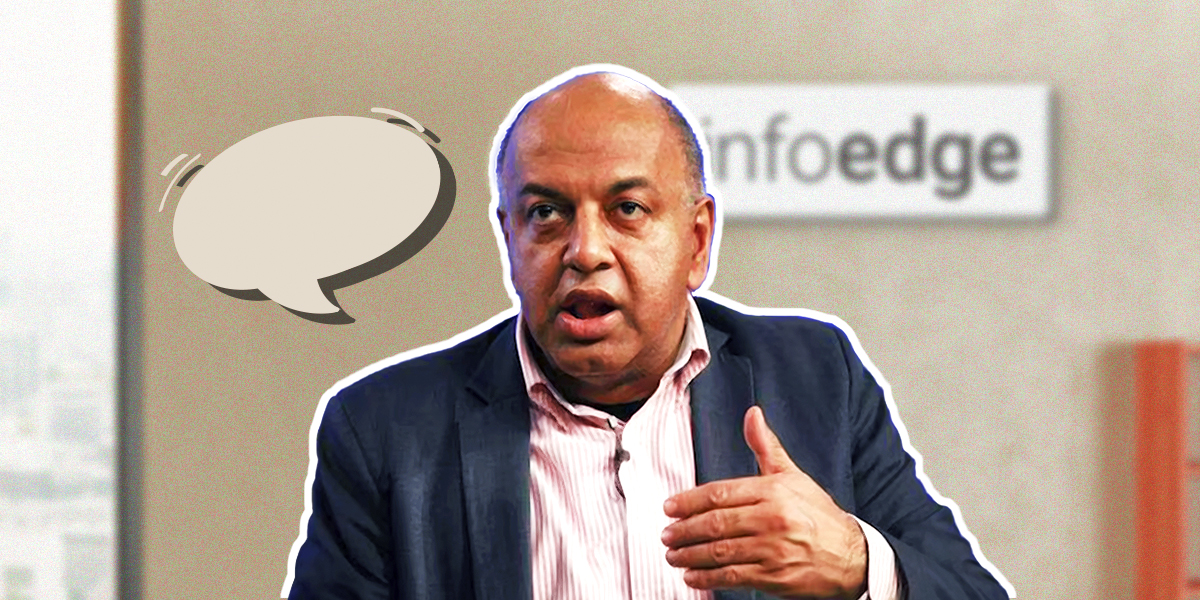
Info Edge, India’s largest and most storied recruitment portal, has had a stellar run in the last three years with its portfolio company Zomato’s market cap surging almost 2.3X since its stock exchange debut. The firm’s bet on fintech unicorn Policybazaar is also paying off well. The company has made it clear it is in no hurry to book profits on these investments, even as it continues to nurse its own brands beyond Naukri to profitability. The firm, one of the few to survive the dotcom boom and bust cycle of 2000, has been led by founder and chairman Sanjeev Bikhchandani for a large part of this journey. And today, Bikhchandani has earned the right to be looked up to as the statesman for the sector. Entrackr caught up with Bikhchandani in his Gurugram office and he spoke on a range of topics including Naukri, Info Edge’s investments, serial entrepreneurs and corporate governance. Here are the edited excerpts. As a listed firm that carries a heavy overhang from its investment portfolio, does it worry you that it might impact the valuation of the core Naukri business? Not really. Institutional investors are smart. We give them adequate data so that they analyze Naukri thoroughly before making a conclusion about valuation. We don’t run Naukri for valuation every day or month or quarter. We look at how we create value for our shareholders in the long run. And that’s how we run our businesses. So, this hypothesis about our core or even group business doesn’t stand. Info Edge has been an investor in Zomato for over 14 years and despite the latter’s share price rising nearly 14o% from its listing price, Info Edge didn’t sell its shares. What level of return are you anticipating from Zomato? Actually, we don’t calculate Investment Return Rate (IRR). Info Edge invested in Zomato because of our conviction that it could become a great company. And if you are convinced about your conviction then it will happen. So, IRR is the happy incidental outcome of investing early behind companies that you want to help. That’s my belief. We are not in any hurry to sell and have an indefinite horizon. Every VC firm has a fund cycle and pressure to return capital to their limited partners but that’s not the case with Info Edge as you are investing from your own balance sheet. Could you elaborate on this? That pressure does not make this choice. We have a long term horizon and we call it patient capital. To be a successful early stage investor in India, you have to be quite patient because companies take anywhere between 10-15 years to go to IPO from seed stage. So if you have funds for only 6-10 years, you will not realize the full fruits of your investment. If you have a 20 year fund, you tend to perform better. However, such a horizon could be possible only when you’re investing from your own whole balance sheet. Do you believe that Blinkit could become bigger than Zomato? I think both are large but Blinkit is going to be fairly large. If we look at Zomato’s quarter-on-quarter numbers, online food ordering appears to have stagnated in top 10-15 cities. What’s your take on this? Obviously, there is the base effect. But, we don’t see stagnation. Also, you need to compare year-on-year, not quarter-on-quarter. When YoY numbers are compared, there is growth. I think full fiscal year performance is more important than quarter. We used to commonly hear about Naukri’s recruitment business that it was not the online presence, but your sales force or feet on the street that made the difference. Does that still hold true? Online sales have never been a big part of our strategy. When you want to sell more expensive products, you need face-to-face contact. At Naukri, we have clients whom we bill several crore rupees for annual subscription and such accounts need heavy offline touch. While the product will be consumed online, the stuff around it very often will be offline. Over the years, several players have tried to crack the recruitment business in the blue collar segment but most of them died. What are the challenges in the segment? Blue collar segment has broadly three challenges. First, it’s hyperlocal. The job seekers in this segment don’t move to different cities as they look for opportunities in and around their locality. Second, very often there isn’t a detailed text CV which makes the process slow and inefficient. Third, potential workforce in the segment do not search for jobs on the laptop and use vernacular languages. They are mostly on mobile. So you’ve got to adapt to all these things and still somehow get revenue and profit. We have been trying to get inroads in the blue collar segment for over two years now but we have just started monetizing it. Our future position in the segment depends on monetization. Some of the celebrated entrepreneurs are launching a second or third company without their first startup churning profit. How do you see this trend? I think this isn’t a progressive trend. As an entrepreneur, you need to focus on one thing and do really well. Once you’ve cracked that you can add on a second thing in the same company. Over the past couple of years, we have witnessed corporate governance issues with some startups. Even Info Edge saw serious lapses at 4B Networks. What’s your opinion about this? By and large, my belief is that 95-98% of Indian founders are genuine but there will be a few bad examples. Investors make sure that when something wrong happens in their portfolio, it is highlighted and actions are taken to ensure that such incidents do not repeat. Any governance issue isn’t good for anyone including limited partners, investors, founders and the startup ecosystem. What factors contributed to the lack of success with Info Edge’s e-commerce investments 99labels, MyDala, and Happily Unmarried? Limitation of raising foreign direct investment (FDI) and heavy investment into competition were two major reasons for failure of 99labels while MyDala had a product market fit (PMF) issue. Happily Unmarried is now a part of VLCC and we are still a shareholder there.

Wingify profit drops over 60% in FY25; revenue up by 34%

EntrackrEntrackr · 2m ago
Wingify profit drops over 60% in FY25; revenue up by 34%
Medial

Everstone-acquired SaaS platform Wingify has continued its steady growth in the last fiscal year ending March 31, 2025. However, the company saw its profits shrink significantly due to a steep rise in expenses. The company’s operating revenue grew 34% to Rs 386 crore in FY25 from Rs 288 crore in FY24, according to its consolidated financial statement sourced from the Registrar of Companies (RoC). The company offers SaaS solutions to online enterprises, supporting them in optimizing their conversion rates through their proprietary tool known as the Visual Website Optimizer (VWO). Income from the services of VWO was the sole source of its income. Including non-operating income of Rs 15 crore, Wingify’s total income stood at Rs 401 crore in FY25 from Rs 301 crore in FY24. Employee benefit expenses were the company’s largest cost component accounting for 68% of the cost, which rose 88% to Rs 257 crore in FY25 from Rs 137 crore in FY24. Legal and professional charges surged 26% to Rs 48 crore, while advertising expenses rose 57% to Rs 22 crore. Overall, Wingify’s total expenses ballooned 70% to Rs 376 crore in FY25 from Rs 221 crore in FY24. Despite the revenue push, the spike in costs compressed profitability. Wingify’s net profit declined 61% to Rs 24 crore in FY25 from Rs 61 crore in FY24. Its ROCE and EBITDA margin decreased to 7.42% and 3.68% respectively. The company spent Re 0.97 to earn a rupee of operating revenue during the year, up from Re 0.77 in the previous year. Wingify’s current assets stood at Rs 216 crore, including Rs 97 crore in cash and bank balances. In January 2025, Wingify announced in a press release that Singapore-based private equity firm Everstone had acquired the bootstrapped SaaS firm, marking one of the largest transactions in the Indian SaaS ecosystem. Co-founder Paras Chopra will retain a minority stake but step away from operational responsibilities, while co-founder and CEO Sparsh Gupta will hold a significant stake and continue to lead Wingify as its chief executive.

RBI grants brief relaxations to Paytm Payments Bank customers

EntrackrEntrackr · 1y ago
RBI grants brief relaxations to Paytm Payments Bank customers
Medial

The Reserve Bank of India (RBI) made brief relaxations on Friday for customers affected by its business restrictions imposed on Paytm Payments Bank Limited (PPBL). The central bank has also released a FAQ section to address key concerns over the move. The RBI has extended the earlier stipulated timeline from February 29, 2024, to March 15, 2024, for further deposits, credit transactions, or top-ups in customer accounts, prepaid instruments, wallets, FASTags, National Common Mobility Cards, etc. The same timeline extension has been given to banking services such as fund transfers, BBPOU, and UPI facilities. Other elements of the original January 31 directive have remained unchanged. For instance, withdrawal or utilization of balances by customers from their accounts, including savings bank accounts, current accounts, prepaid instruments, FASTags, National Common Mobility Cards, etc., are allowed without any restrictions, up to their available balance. The bank, however, also maintained that the nodal accounts of One97 Communications Ltd and Paytm Payments Services Ltd maintained by PPBL are to be terminated at the earliest, in any case not later than February 29, 2024. The central bank further directed that the PPBL should ensure withdrawals upto available balance from all accounts and wallets except for those frozen or flagged by the law enforcement authorities or judicial authorities. “Further, it is directed that the bank shall facilitate a seamless withdrawal of customer deposits that are parked with partner banks under the automatic ‘sweep-in sweep-out’ facility without causing any inconvenience to such customers,” the bank said. Earlier this week, RBI deputy governor Swaminathan J clarified that the crackdown on Paytm’s payments bank was not sudden but followed several conversations and giving the company ample time to take corrective measures. “When constructive engagement doesn’t work or when the regulated entity does not take effective action, we go for imposing business restrictions,” Das is quoted as saying. Paytm has said it is working with the authorities to resolve the matter. According to reports, Paytm founder Vijay Shekhar Sharma held meetings with Finance Minister Nirmala Sitharaman over the crisis faced by the company’s banking vertical. But it appears there has been no immediate relief for the company. Following the RBI notification, Paytm’s shares have continued to nosedive to hit all-time low. Though on Friday, it surged 5% to Rs 341.50 from the previous close of Rs 325.25 on the BSE. Some of the key question- answers posted by the RBI on the business restriction on the Paytm bank are as follows: Q: My salary is credited into my account with Paytm Payments Bank. Can I continue to receive my salary into this account? RBI: No. After March 15, 2024, you will not be able to receive any such credits into your account with Paytm Payments Bank. It is suggested that you make alternative arrangements with another bank before March 15, 2024 to avoid inconvenience. Q: I receive a subsidy or certain direct benefit transfers linked to my Aadhar from the Government in my account with Paytm Payments Bank. Can I continue to receive it into this account? RBI: No. After March 15, 2024, you will not be able to receive any such credit into your account with Paytm Payments Bank. Please arrange to change your linked account to another bank before March 15, 2024 to avoid any inconvenience or disruption. Q: I have a FASTag issued by Paytm Payments Bank. Can I continue to use it to pay toll after March 15, 2024? RBI: Yes. You can continue to use your FASTag to pay toll upto the available balance. However, no further funding or top ups will be allowed in the FASTags issued by Paytm Payments Bank after March 15, 2024. It is suggested that you procure a new FASTag issued by another bank before March 15, 2024 to avoid any inconvenience. You can check out the complete FAQs here.

Hypergro.ai leverages AI for marketing efficiency and targeting

EntrackrEntrackr · 1y ago
Hypergro.ai leverages AI for marketing efficiency and targeting
Medial

Hypergro.ai is a new-age generative AI startup that focuses on solving core marketing problems for brands, such as identifying and understanding target audiences, providing actionable insights on consumer behavior, preferences, patterns, and more. The Bengaluru-based company has also raised funding from investors such as Silver Needle Ventures, HME Ventures, and Dholakia Ventures, among others. We spoke to the company’s Co-founder and CBO, Neha Soman, to learn more about Hypergro.ai, what distinguishes it from the competition, and the roadmap ahead. Here are the edited excerpts: How did you come up with this idea? Hypergro.ai was born from a vision to redefine marketing in the AI era. Drawing from our extensive experience as content creators as well as product and tech within major Indian social media firms like ShareChat and Glance, it has given us deep insights into social media trends and algorithmic intricacies. These experiences showed us the enormous potential of AI in crafting more nuanced and effective marketing strategies that align with the evolving digital landscape. How does the platform work? Please help simplify the process. Hypergro.ai acts as a comprehensive solution for all marketing needs. By utilizing AI, the platform identifies the perfect customer profiles, crafts tailored messages, creates personalized content, and ensures precise ad targeting—all automatically and in real-time, enhancing efficiency and reducing costs. Hypergro.ai functions through an automated process designed to optimize marketing efforts efficiently. It starts by identifying detailed customer personas, which involves analyzing data to understand the different potential customers who might be interested in the product. This data-driven approach allows Hypergro.ai to pinpoint specific characteristics such as age, interests, and buying habits, creating a comprehensive profile for each customer group. Once these personas are established, Hypergro.ai assists in developing tailored messages that resonate specifically with each identified group. This personalization ensures that communications are not only relevant but also engaging to each type of customer. Following this, the platform aids in the creation of content suited to these personas. The key to Hypergro.ai’s approach is not just creating content but also ensuring it reaches the right audience. To achieve this, the platform employs sophisticated AI algorithms for precise ad placement. This means deciding on the most effective platforms and times to display these ads, ensuring they are seen by the intended demographic, maximizing both engagement and impact. Lastly, the entire process is automated and continuously optimized in real time. Hypergro.ai learns from the outcomes of each campaign, making intelligent adjustments to both content and ad placements. This dynamic optimization helps improve the effectiveness of marketing campaigns, ensuring better results while saving time and resources. Through this comprehensive, AI-driven approach, Hypergro.ai helps brands reach their marketing goals with greater precision and efficiency. Please help understand how you generate revenues. Our revenue model is based on a subscription framework where brands can choose from a variety of packages tailored to their needs. These packages provide access to our advanced AI tools for content generation, performance analytics, and tailored advertising solutions. This model allows for flexibility and scalability, accommodating the varying needs of small startups to large enterprises What are the key challenges in the industry that have not been addressed yet? The digital marketing industry often struggles with the dual challenges of automating processes while maintaining a personalized touch in customer interactions. Traditional marketing techniques can be indiscriminate and impersonal. Hypergro.ai tackles this by integrating cutting-edge AI to offer hyper-personalized marketing solutions that not only identify but also predict customer preferences and behaviors, setting a new standard for what targeted marketing can achieve. How has your startup performed since inception? Please share statistics. Since our inception, Hypergro.ai has seen exponential growth. Our platform now supports a vibrant community of over 300,000 creators across India, and we have collaborated with more than 100 brands to fine-tune our AI capabilities. This synergy has led to our AI model enhancing its accuracy significantly, leading to measurable improvements in revenue generation for our clients—demonstrating the tangible benefits of our AI-driven approach. What are your short-term and long term goals in terms of product and business expansion and diversification? Our immediate objective is to refine our AI models to offer even more precise and effective marketing tools, ensuring brands feel their investment is directly contributing to visible and substantial outcomes. Over the long term, we aspire to revolutionize the agency model not just in India but globally, starting with strategic expansions into the US and UAE markets. Our goal is to transform Hypergro.ai into a benchmark for performance marketing worldwide.

How profitable InCred stands out among bleeding fintech lenders: Interview with Bhupinder Singh

EntrackrEntrackr · 1y ago
How profitable InCred stands out among bleeding fintech lenders: Interview with Bhupinder Singh
Medial

Lending has turned out to be the most obvious money making channel for fintech startups in India. Right from large to small fintech companies are resorting to distributing loans through own and third party lenders such as banks and NBFCs. Most growth stage fintech startups have been lending aggressively, but they still bear huge losses on a consolidated basis. However, the eight-year-old InCred is an exception as the firm’s operating revenue spiked 48% to Rs 1,267 crore in FY24. At the same time, its profit grew 160% to Rs 316 crore in FY24. InCred claims to have offered credit to 3,50,000 borrowers since its inception in 2016. InCred group operates three companies – InCred Finance, InCred Capital, and InCred Money. To understand InCred’s growth across segments, startup investments including Oyo and collection (recovery) among others, Entrackr spoke to the company’s founder and chief executive Bhupinder Singh. Here are the edited excerpts. How has the size of asset under management (AUM) across personal, education and business loans grown? Our asset under management or AUM grew 49% in FY24 and we closed FY24 with over Rs 9,000 crore in AUM, spread across personal loans which accounts for 44% of our AUM while micro, small and medium enterprises (MSMEs) contributed 35% of the total disbursal. Educational loans formed 21% of the entire loan book including third-parties capital. Can you talk about growth numbers across three segments: personal, business and educational in the last fiscal year? We have had strong growth across all three segments in FY24: Personal loans grew at 57% whereas educational loans spiked at 86%. Business (MSMEs) borrowing increased 32% during the last fiscal. Which factors led to the upsurge in educational loans? Strong preference to study abroad for superior exposure and growth prospects, along with growing awareness in terms of universities and courses through social media and internet are some of the key driving factors, which have accentuated further over the last few years. InCred has started equity investment across startups. Why has it entered into what’s widely dubbed as risky equity investment? We invest in startups through InCred Capital where we focus on identifying attractive investment opportunities in private companies. However, we only put money in startups which are available at reasonable valuations and have long-term structural growth potential. Besides InCred Capital, we also have a private equity fund providing growth capital to startups and other businesses. You said that InCred Capital looks for reasonable valuation while investing into startups. InCred capital recently invested in Oyo at a $2.38 Bn valuation. Do you think this is the right valuation of Oyo? Any investment opportunity we identify for our clients is based on our fundamental thesis of providing an attractive risk-return profile for our wealth clients. We believe that Oyo falls in that category and provides an opportunity for long term value creation. Collection is the hardest part of any form of lending be it traditional or digital. How did InCred solve this and what’s the size of NPA? Agreed. I think it starts right from our strong, proactive focus on risk and analytics, and then collections, which is more reactive. We have over 150 pan-India collections teams across products that track repayments and employ multiple modes, depending upon the product-specific requirement and level of customer delinquency. For early defaulters, we use techniques like tele-calling to educate them about default implications such as credit score deterioration. For late-stage defaulters, focus is more on limiting losses through field visits, vendor engagement among others. We also use mechanisms like setting up escrow accounts for superior collections. InCred efficiency has been consistently tracking at 98%. Our March 2024 NNPA stood at 0.8% and was among the best in the industry. InCred merged with KKR Financial services in 2022. How has the merger panned out in terms of business? Let me start by giving you some context. While technically it was a reverse merger of InCred with KKR India’s credit arm, substance over form, InCred acquired KKR’s corporate loan book. It was a win-win for both InCred and KKR. What KKR got was a profitable exit from its corporate book, which they were looking for, and the opportunity to be part of a successful and long-term lending growth story with InCred in the driver’s seat. For InCred, the deal was purely an equity raising exercise with KKR joining our cap table and our net worth swelling 3X to over Rs 3,200 crore as of December 2023. At the same time, we were able to quickly wind down the corporate loan book and focus on building a granular retail franchise, which is our broad vision for InCred Finance.

Download the medial app to read full posts, comements and news.