News on Medial

Related News

Fasal reports Rs 34 Cr revenue in FY24; earns 91% from fruit sales

EntrackrEntrackr · 1y ago
Fasal reports Rs 34 Cr revenue in FY24; earns 91% from fruit sales
Medial

Agritech startup Fasal raised $12 million led by TDK Ventures and British International Investment (BII) in December last year. The significant funding seems to have given cushion to the six-year-old firm which earned only Rs 58 crore since its inception in 2018. Fasal’s revenue from operations increased 89% to Rs 34 crore in FY24 from Rs 18 crore in FY23, as shown in its annual financial statements filed with the Registrar of Companies (RoC). Founded in 2018, Fasal leverages AI, crop sciences, and IoT to deliver crop-stage-specific intelligence which optimizes resources and enhances productivity. Despite such strong focus on tech, only 9% of the firm’s total revenue ~Rs 3 crore came from these services. Meanwhile, Fasal made 91% of its revenue from selling fruits. For the agritech model which eventually converted into a supply chain, the cost of procurement was naturally the largest cost center which accounted for 47% of the overall expenditure. To the tune of scale, this cost increased 83% to Rs 33 crore in FY24. Its employee benefits, legal, advertising cum business promotion, packaging, forwarding, and other overheads pushed the overall cost to Rs 70 crore in FY24 from Rs 52 crore in FY23. See TheKredible for the detailed cost breakup. At Rs 30 crore, the increase in fruit sales helped Fasal to contain its losses in FY24. Its ROCE and EBITDA margin hovered at -45.7% and -80%, respectively. On a unit level, the firm spent Rs 2.06 to earn a rupee in the fiscal year ending March 2024. FY23-FY24 FY23 FY24 EBITDA Margin -146.32% -80% Expense/₹ of Op Revenue ₹2.89 ₹2.06 ROCE -163.53% -45.71% Fasal has raised $18 million to date including its pre-series of $4 million in 2021. According to the startup data intelligence platform TheKredible, Omnivore is the largest external stakeholder with 15.99% followed by 3One4 Capital. See TheKredible for the complete shareholding pattern. By now, far too many agritech startups have followed the same pattern. Start off with a heavy on tech proposition that promises to disrupt farming itself, before discovering it’s just too difficult to move the needle there. And while at it, spot an alleged opportunity in price arbitrage between farmer rates and retail rates, and turn a seller. For one, this pattern is flawed simply because most of these startups are mistaken if they think they can negotiate better than the established network of traders on the ground. That is probably why we see startups allegedly selling farm fresh fruits and veggies still retailing stuff that can be a 100% premium to the push cart based sellers. On top of that are quality issues of depending on luck versus the hand picked comfort of buying yourself. Finally, the search for margins leads to a gradual spread of the portfolio or Sku’s, a surefire recipe to burn through funding faster. If it’s ever going to work, it might work for a handful of startups. For the rest, we have to wonder just what it will take.

Profitable bootstrapped D2C brand Blue Tea projects Rs 65 Cr sales in FY26

EntrackrEntrackr · 11d ago
Profitable bootstrapped D2C brand Blue Tea projects Rs 65 Cr sales in FY26
Medial

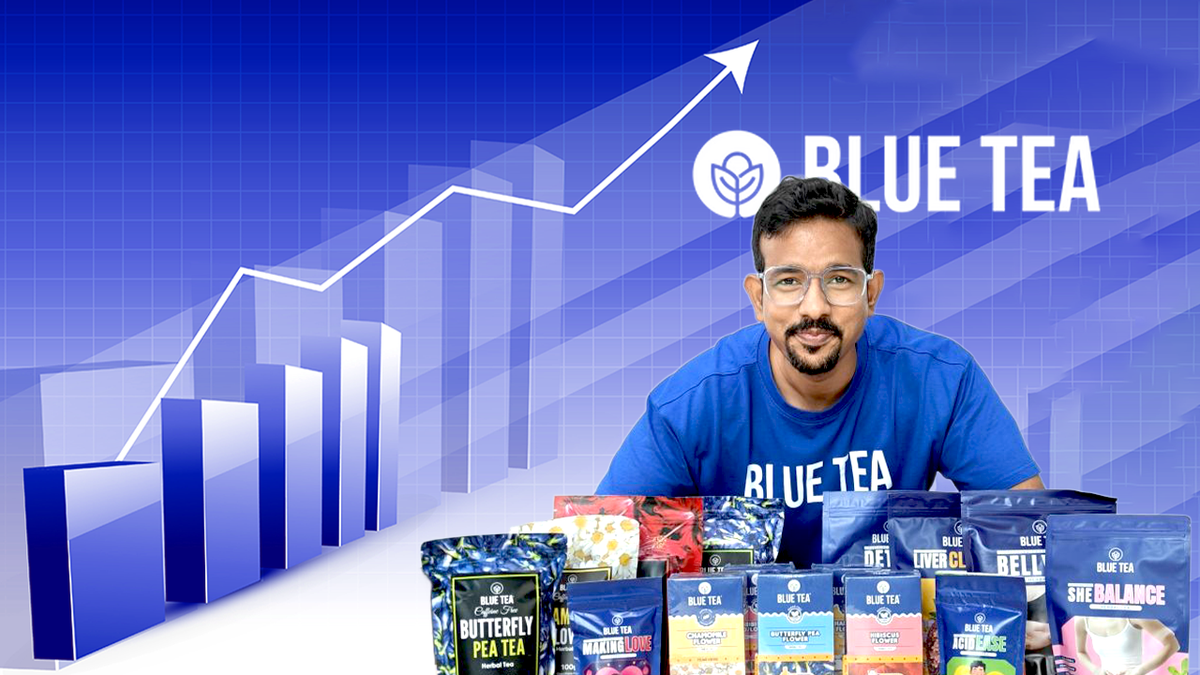
Profitable bootstrapped D2C brand Blue Tea projects Rs 65 Cr sales in FY26 Bootstrapped herbal wellness brand Blue Tea recorded more than 46% year-on-year growth in operating revenue to Rs 37 crore in the fiscal year ended March 2025. With decent growth, the firm remained profitable during the year. Speaking to Entrackr, co-founder Nitesh Singh said the growth was driven by higher order frequency and deeper channel penetration, with the brand recording a 68% increase in annual recurring revenue (ARR). India contributed nearly 80% of total revenue, while international markets made up the remainder, he added. Commenting on the minor decline in profit, Singh said that it was a consequence of short-term headwinds in the US market, which the brand expects to be resolved in FY26. The standalone India business showed a strong upside, with a 75% year-on-year growth in net profit. Importantly, Blue Tea has now built a customer base of over 25 lakh consumers, a sign of strong brand recall and repeat consumption in the herbal wellness category. Now, the brand has been expanding its footprint beyond metro cities, and nearly 59% of domestic sales now originate from non-metro and non-tier I markets, which signalled wider awareness and adoption of herbal wellness beverages across smaller cities. “Our own website contributed around 50% of India's revenue as of December 2025,” said Singh. Quick commerce has emerged as a breakout lever in FY25 for Blue Tea. “We reported a 20X surge over the last six months across platforms such as Blinkit, Flipkart Minutes, Amazon Now, and Zepto,” stressed Singh. It’s currently selling approximately 5,200 units per day across channels including quick commerce. “Over the last 36 months, India's sales have increased 20X,” he added. Blue Tea operates in what Singh estimates to be a $6 billion wellness beverage market, led by rising consumer preference for caffeine-free, plant-based and functional drinks. Started in 2018, the company follows a farm-to-cup sourcing model and works directly with more than 600 farmers, enabling quality-controlled procurement and supply chain transparency while maintaining margin discipline. “We have already clocked Rs 52 crore in revenue till January in the ongoing fiscal year and are projecting Rs 65 crore for FY26, targeting over 60% year-on-year growth with a sharper focus on quick commerce and distribution expansion,” said Singh. Over the next three years, the company aims to scale to Rs 350 crore in revenue. With profitability intact, deeper penetration in non-metros and quick commerce, Blue Tea appears to be building scale through distribution strength and repeat behaviour rather than discount-driven growth.

Download the medial app to read full posts, comements and news.