

Back

Rahul Agarwal
Founder | Agentic AI... • 6h
Deconstructing How Agentic AI Actually Works We’ve all experienced what Large Language Models can do — but Agentic AI is the real leap forward. Instead of just generating responses, it can understand goals, make decisions, and take action on its own. Here’s a clean breakdown of the layers that give Agentic AI its autonomy: 1 - Input Sources: How an Agent Perceives the World A capable agent never depends on just one stream of information. It gathers context from multiple channels, much like a human: Knowledge Bases: Internal documents, wikis, code, and institutional learning. User Inputs: Goals, instructions, and conversational cues. APIs: Live data from external platforms and services. Sensors: Data from the physical environment (IoT devices, cameras, etc.). These inputs act as the agent’s senses. 2 - AI Processing: The Brain of the Agent This is where raw information becomes understanding and strategy. Intent & Context Understanding: Parsing what the user really wants and maintaining continuity. Reasoning + Memory: Pulling insights from past interactions or long-term stored knowledge. Planning & Tool Selection: Creating a sequence of steps and choosing the best tools, APIs, or systems to execute them. This layer is the cognitive core that turns data into decisions. 3 - Action Layer: Where Thinking Turns Into Doing This is what truly separates Agentic AI from traditional LLMs. Decision-Making & Task Execution: Breaking complex goals into executable steps and completing them. Multi-Agent Collaboration: Delegating work to other specialized agents when needed. Self-Correction: Identifying mistakes, adjusting plans, and learning from failures. Autonomous Scheduling: Running processes proactively—without waiting for prompts. This is the operational muscle behind autonomy. 4 - Output: Delivering the Final Insight After processing and execution, the agent produces a clear, concise result—often backed by real actions already taken in the background. * Why This Matters for Leaders Agentic AI doesn’t just automate tasks. It works toward outcomes. For product teams, think of agents as intelligent micro-services that can link into your APIs, databases, and workflows—then coordinate themselves to run complex business operations end-to-end.
More like this
Recommendations from Medial


AIGuts
Exploring AI's poten... • 7m
What’s the Difference Between Agentic AI and Generative AI? As artificial intelligence advances in complexity and capability, two major branches—Agentic AI and Generative AI—are beginning to shape distinct roles in technology and society. This guide
See More



Account Deleted
Hey I am on Medial • 9m
Why India’s Biggest Companies Are Betting on Agentic AI Agentic AI refers to autonomous GenAI agents capable of performing complex tasks with minimal human supervision. Indian companies, from startups to enterprises like Zomato, Infosys, and Zoho,
See More

Ashish Bhat
Founder @ Hueman AI ... • 8m
Understanding the Evolution of AI: From Generative to Agentic Intelligence As AI continues to transform industries, it’s crucial to understand the distinct layers in its evolution: 1. Generative AI At its core, Generative AI (like ChatGPT or Midjou
See More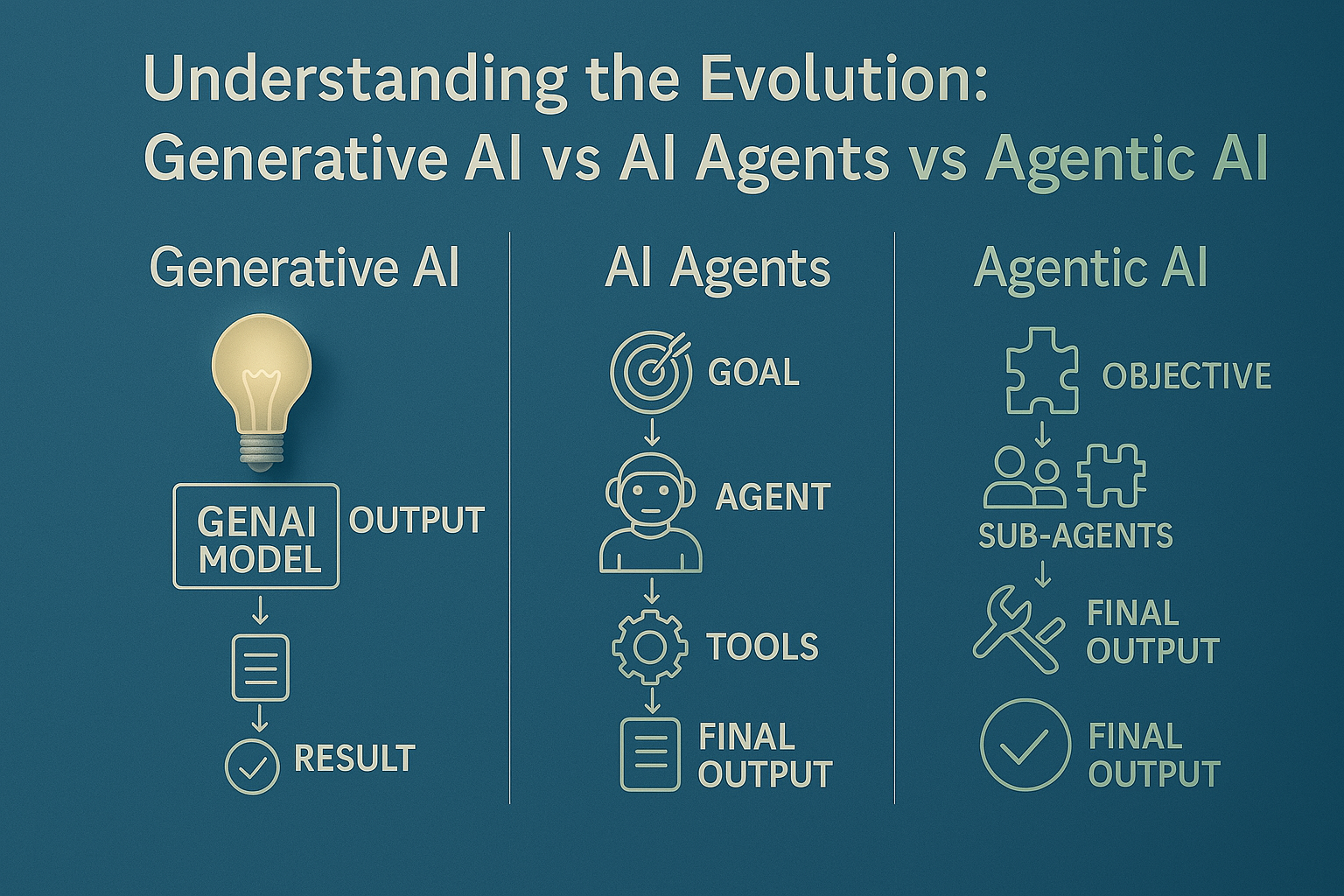

Priyansh Khimani
AI Automation | Grow... • 8m
🚀 Agentic AI: The Future of Autonomous Automation 🤖 Agentic AI is transforming how we automate and make decisions. Unlike traditional AI, which follows strict commands, Agentic AI acts independently, sets goals, adapts, and executes tasks with min
See More



























Download the medial app to read full posts, comements and news.